Vitamin D3 for Bearded Dragons: UVB, Supplements and Safe Levels
Vitamin D3 lets a bearded dragon absorb and use calcium. Dragons make it in their skin under UVB light, so a linear T5 UVB tube is the main source and powder D3 is a backup. Too little D3 leads to metabolic bone disease. Too much, almost always from overused supplements, causes calcium deposits in the organs. Get the UVB right, use calcium with D3 on a set schedule, and see a reptile vet if you notice tremors, a soft jaw or weak legs.
Table of Contents
- What Vitamin D3 Does
- How Dragons Make Vitamin D3
- UVB vs Supplements
- Common Myths
- Signs of Too Little or Too Much
- Practical Steps
🦎 Want all the essentials on one printable page?
The Complete Bearded Dragon Care Plan puts daily routines, feeding charts, safe vs. toxic foods and vet red flags into one 16-page PDF for $7.99.
See the Care Plan →Key takeaways
| Point | Details |
|---|---|
| Role | Vitamin D3 controls how much calcium the gut absorbs and how the body uses it. |
| Main source | UVB light on the skin. Use a linear T5 tube with a UV index of about 4 to 6 at the basking spot. |
| Backup source | Calcium with D3 powder on a set schedule. |
| Too little | Metabolic bone disease: tremors, soft jaw, weak and swollen legs. |
| Too much | High blood calcium and deposits in kidneys, heart and blood vessels. |
What Vitamin D3 Does
Vitamin D3 works like a hormone. In its active form it tells the gut to absorb calcium, and it helps control how calcium moves between the blood and the bones. Without enough D3, a dragon absorbs little of the calcium it eats and starts to take calcium from its bones. The result is metabolic bone disease, one of the most common illnesses in pet bearded dragons.
- raises calcium absorption in the gut
- helps keep calcium and phosphorus in balance in the blood
- supports bone growth and repair
- supports normal muscle and nerve function
How Dragons Make Vitamin D3
- UVB light reaches the skin and turns a cholesterol-based compound into pre-vitamin D3.
- Body heat turns it into vitamin D3. This is one reason a warm basking spot matters.
- The liver and kidneys convert it into the active hormone, calcitriol.
- Calcitriol raises calcium uptake in the gut and supports bone building.
Skin production has a built-in limit: under long UVB exposure, extra pre-vitamin D3 breaks down into inactive compounds. Powder D3 has no such limit, which is why overdose comes from supplements, not from correct UVB.
UVB vs Supplements
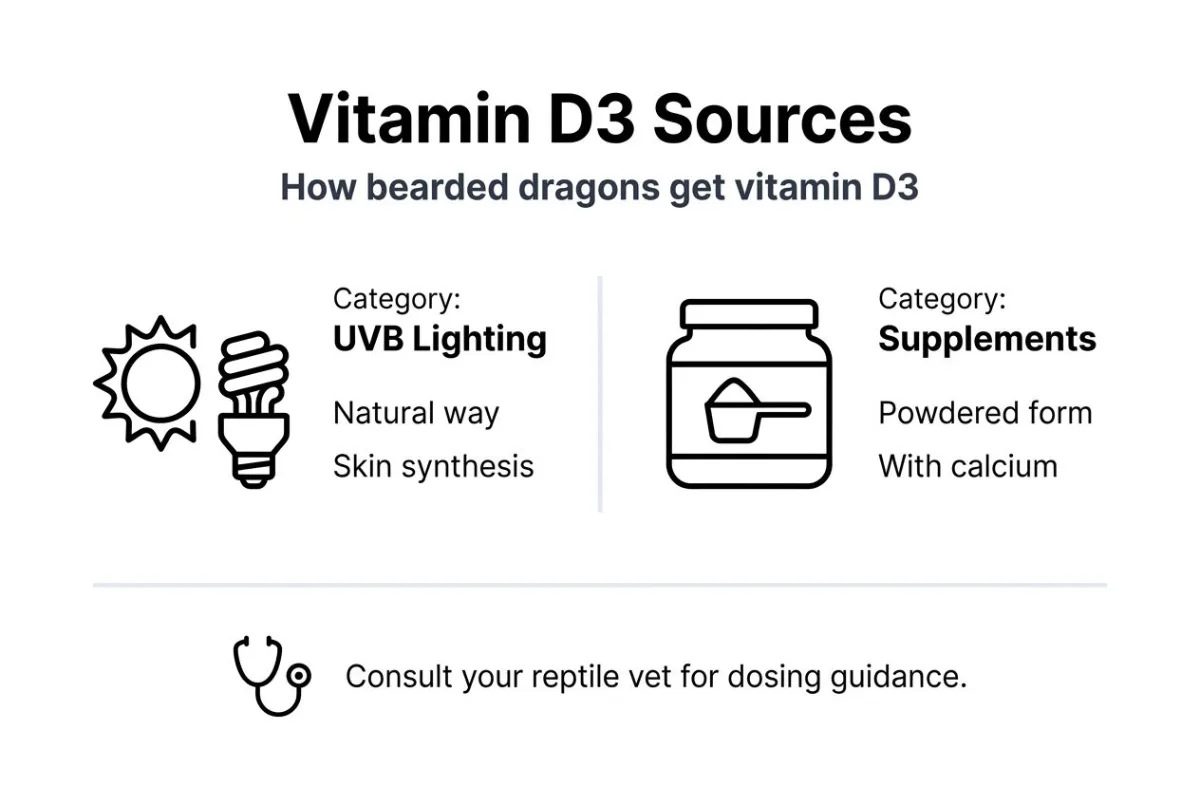
| Source | Advantages | Limits |
|---|---|---|
| UVB light | Natural, self-limiting, also supports behavior and well-being | Tubes weaken with age, glass and plastic block UVB, distance matters |
| Calcium with D3 powder | Easy backup, useful while UVB is being fixed | Overdose possible, cannot replace UVB |
For more background, see this research article on reptile UVB. For setup details, read our UVB lighting guide.
Use reptile calcium powders with D3, such as these reptile calcium supplements with D3. Avoid concentrated D3 products made for other animals, which make safe dosing almost impossible.
Common Myths
- “Powder D3 replaces UVB.” It does not. Dragons on powder alone still develop problems, and UVB supports more than D3 production.
- “Vitamin D2 works too.” Reptiles use D3 far better than D2. Choose products with D3 (cholecalciferol).
- “More D3 is safer.” Too much D3 causes calcium deposits in the kidneys and other organs.
- “A glowing bulb still gives UVB.” UVB output drops long before the visible light fades. Replace T5 tubes every 12 months and T8 tubes every 6 months.
- “Light through a window counts.” Window glass blocks most UVB.
Signs of Too Little or Too Much
| Too little D3 (and calcium) | Too much D3 |
|---|---|
| Lethargy and a poor appetite | Lethargy and a poor appetite |
| Twitching toes, tremors | Weakness |
| Soft or swollen jaw | Constipation |
| Swollen or bowed legs, kinked spine | Kidney problems |
| Broken bones from small falls | Calcium deposits found on X-ray or blood tests |
Both lists share some signs, so only a vet can tell them apart with blood tests and X-rays. More background is in the veterinary literature. Do not try to fix a suspected problem by changing powders on your own. See a reptile vet, and compare your dragon with our list of signs of a healthy bearded dragon.
Practical Steps
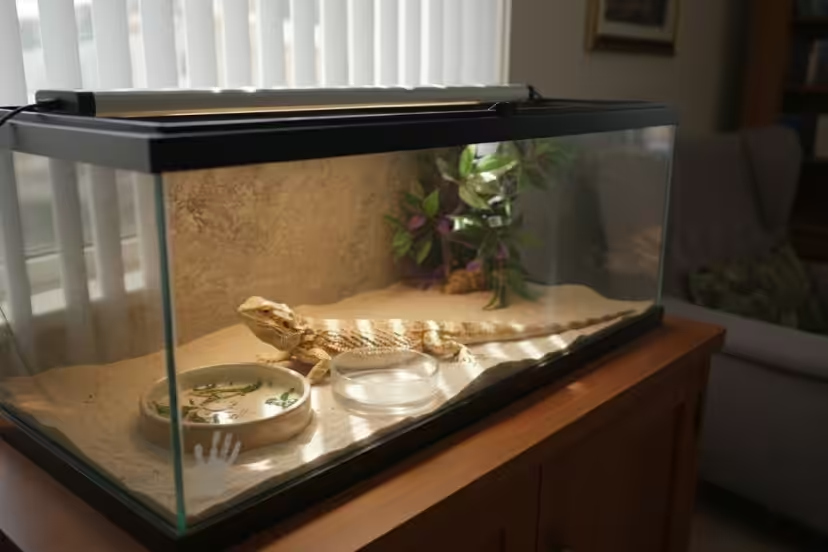
- Install a linear T5 high-output UVB tube across about half the enclosure on the basking side. Aim for a UV index of about 4 to 6 at the basking spot. Follow the maker’s distance chart and remember that mesh blocks part of the UVB.
- Run it 10 to 12 hours a day on a timer, together with the basking lamp.
- Give a shaded area so your dragon can move out of the UVB zone.
- Replace the tube on time: T5 every 12 months, T8 every 6 months.
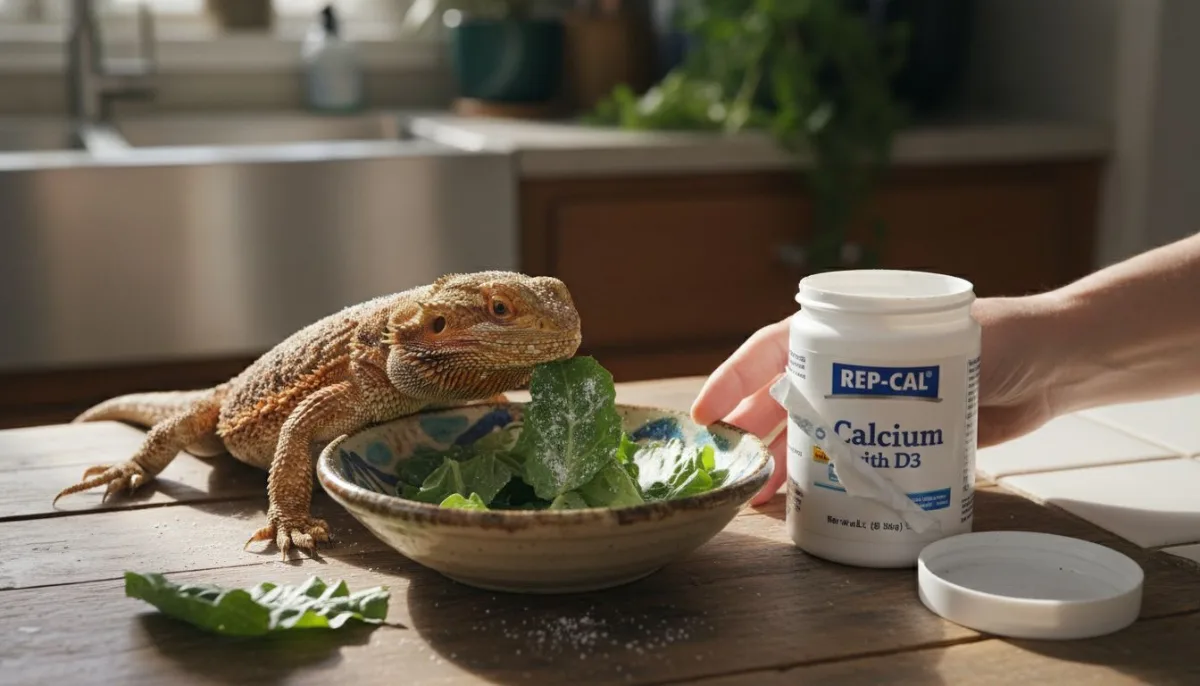
- Use calcium with D3 two to three times a week for babies and juveniles and once a week for adults, with plain calcium on the other insect meals.
- Check the UV index with a UV meter if you can, in particular after moving the lamp or changing the tube.
- Book a yearly vet visit and ask about bone health.
Our guide to supplements and bone disease prevention and our supplement overview cover the full schedule.
Conclusion
Strong UVB is the foundation, powder D3 is the backup, and a reptile vet is the judge when something looks wrong. Replace UVB tubes on schedule, keep D3 powder to a set routine and avoid concentrated D3 products.
Related Guides

Read our UVB and basking setup guide and our guide to choosing supplements.
FAQ
How often should I replace UVB bulbs for my bearded dragon?
Replace a T5 tube every 12 months and a T8 tube every 6 months, even if it still glows. Follow the maker’s advice for other lamp types.
Can I rely on vitamin D3 supplements without UVB lights?
No. Every bearded dragon needs UVB. Powder D3 is a backup, not a replacement.
How often should I give calcium with D3?
Two to three times a week for babies and juveniles and once a week for adults, with plain calcium on the other insect meals. Follow the label and your vet’s advice.
Can a bearded dragon get too much UVB?
Yes. A UV index far above 6 at the basking spot can damage the eyes and skin. Keep a shaded area and follow the maker’s distance chart.

Love your beardie? Wear it proudly.
Be a Bearded Dragon Scented Candle – from $21.47. Our own bearded dragon designs, printed on demand. Every order supports these free care guides.
View this design → Browse all gifts