Why Bearded Dragons Stack – Revealing Social Instincts
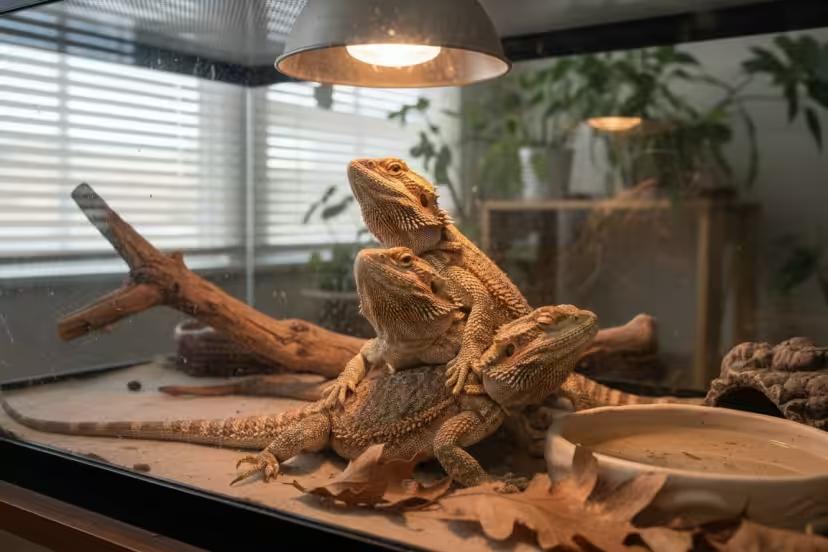
Most families are surprised to learn that bearded dragons regularly climb on top of each other, forming what experts call stacking behavior. This quirky habit is more than a random pile-up and can provide vital clues about temperature regulation and social hierarchy. Understanding why stacking happens helps owners avoid health risks and create happier habitats. Gain practical insight into how group dynamics work so you can spot problems early and support your dragon’s wellbeing.
Table of Contents
- Bearded Dragon Stacking Defined
- Types and Patterns of Stacking Behavior
- Social Hierarchy and Dominance Signals
- Risks of Stacking for Pet Health
- Managing Group Housing Effectively
Key Takeaways
| Point | Details |
|---|---|
| Stacking Behavior | Bearded dragons stack to establish social hierarchy and regulate body temperature, offering a unique insight into their social dynamics. |
| Types of Stacking | Stacking behavior varies by age, gender, and environmental conditions, with cooperative stacking more common among juveniles and females. |
| Risks of Stacking | Stacking can lead to physical injuries and chronic stress, particularly for smaller or submissive dragons beneath larger, dominant individuals. |
| Group Housing Management | Successful group housing requires adequate space, multiple basking areas, and careful monitoring to prevent stress and injuries among dragons. |
Bearded Dragon Stacking Defined
Bearded dragons have a fascinating social behavior known as stacking, where these scaly companions literally climb on top of each other in what might seem like an unusual reptilian cuddle pile. Social behaviors in central bearded dragons reveal this isn’t just random positioning but a complex communication method.
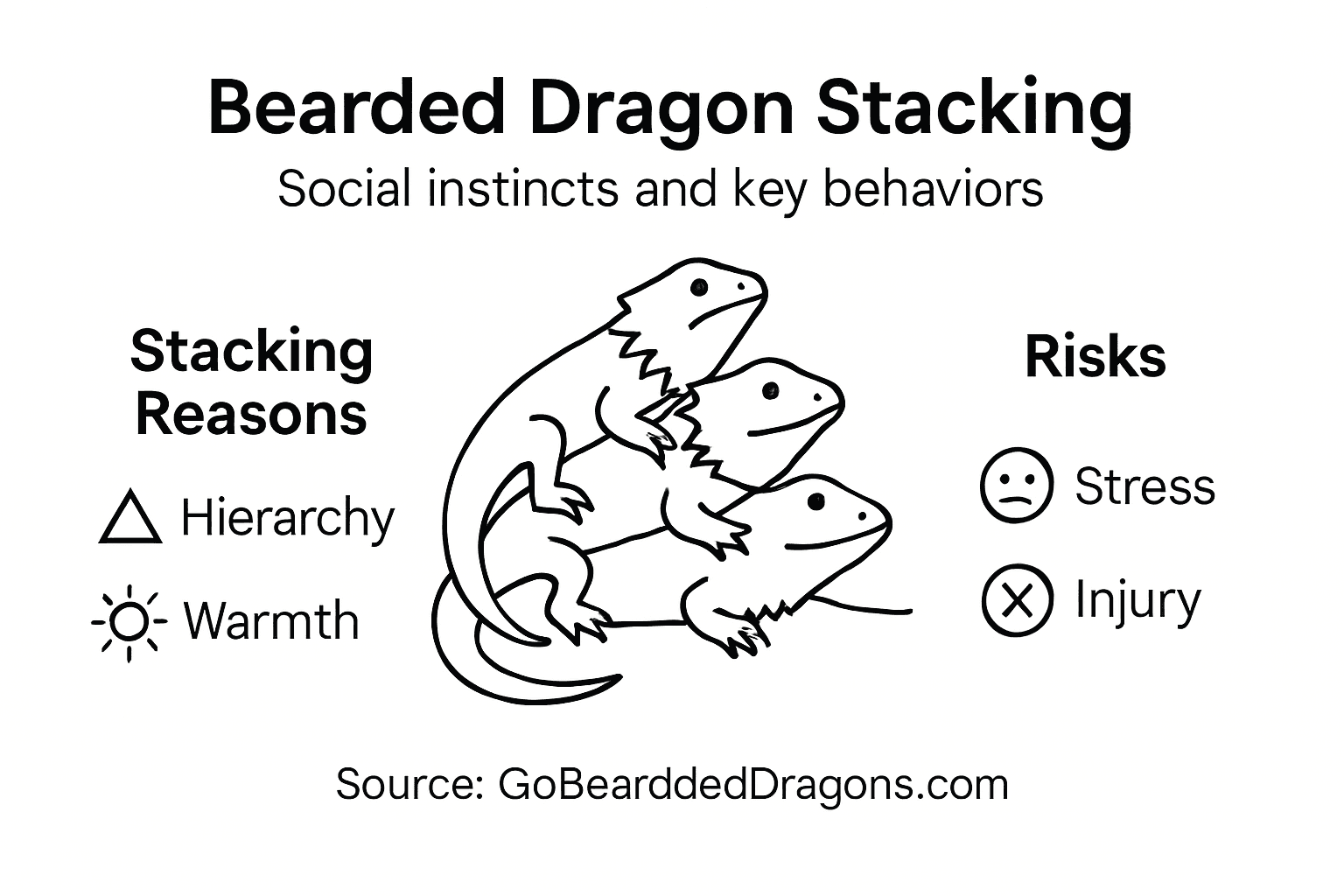
Stacking isn’t simply about finding a cozy spot. For bearded dragons, it’s a multilayered interaction that serves several critical functions. Dominant dragons typically position themselves at the top of the pile, using this physical arrangement to establish social hierarchy. The dragons underneath demonstrate submission by allowing themselves to be used as literal stepping stones. This behavior goes beyond simple territorial displays and represents a nuanced social communication strategy unique to these remarkable reptiles.
Thermoregulation plays another significant role in stacking behavior. By positioning themselves on top of each other, bearded dragons can efficiently manage their body temperature, especially in environments with limited warm spots. The dragons at the bottom benefit from shared warmth, while those on top gain prime basking positions. This cooperative approach demonstrates the intricate social intelligence of these seemingly simple creatures.
Pro tip: When observing multiple bearded dragons, pay close attention to their stacking order to understand their social dynamics and potential stress levels.
Types and Patterns of Stacking Behavior
Bearded dragons display surprisingly complex stacking patterns in group settings, revealing intricate social dynamics beyond simple physical positioning. These patterns vary dramatically depending on factors like age, gender, social hierarchy, and environmental conditions. Understanding these nuanced interactions helps reptile enthusiasts decode the sophisticated communication happening right before their eyes.
In juvenile groups and female populations, stacking behavior tends to be more frequent and cooperative. Dominant individuals typically occupy the top positions, creating a living hierarchy where each dragon’s placement communicates critical social information. Size plays a significant role – larger dragons often position themselves strategically to control the best basking spots, while smaller dragons adapt and stack accordingly. This positioning isn’t random but a carefully negotiated social arrangement that reflects complex reptilian social intelligence.
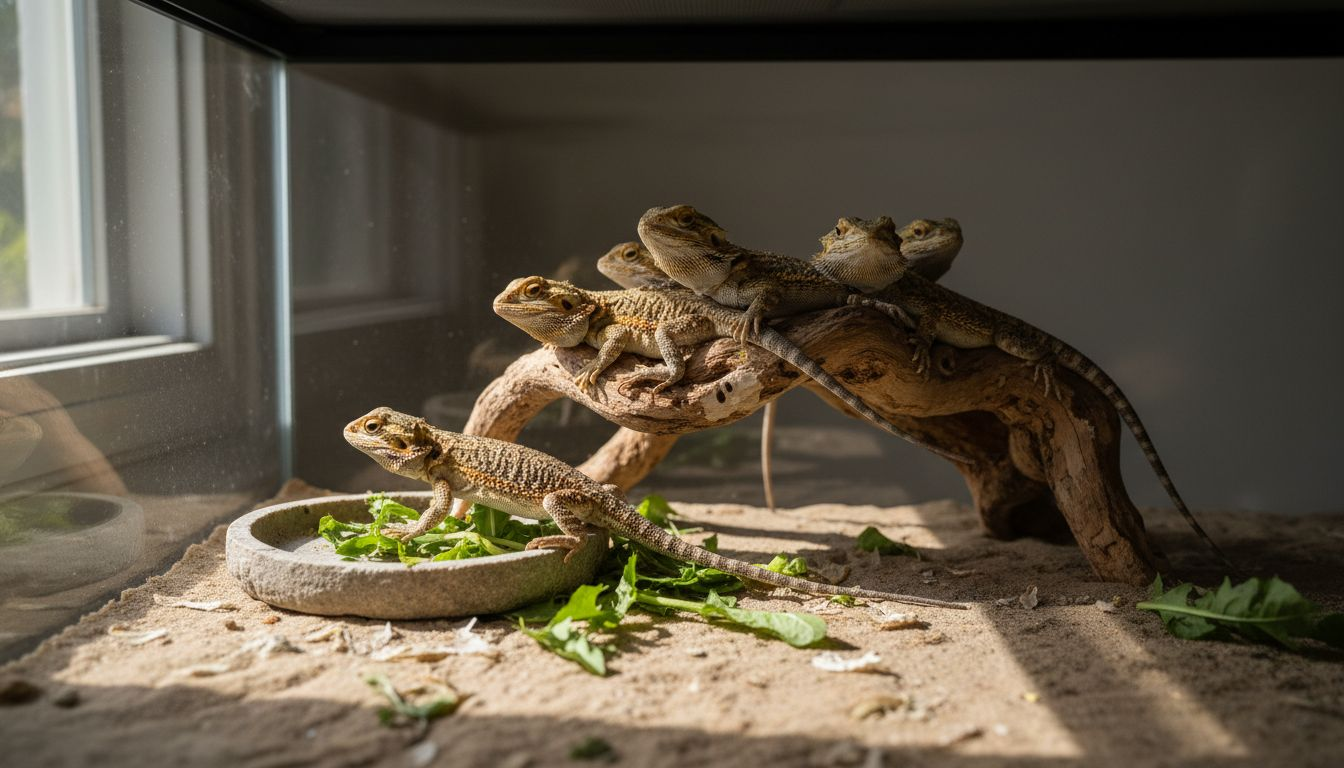
The environmental context dramatically influences stacking patterns. In confined spaces like terrariums, bearded dragons might stack more frequently to share limited warm areas. Temperature gradients, available space, and the number of dragons in a habitat all contribute to the frequency and style of stacking. Reptile behavioral observations suggest that male bearded dragons are less likely to stack due to their more territorial nature, making group stacking a more nuanced behavior among females and juveniles.
Pro tip: Monitor your bearded dragons’ stacking behavior as a key indicator of their social health and potential stress levels in shared habitats.
Here’s a quick reference to the main types of stacking behavior and what influences them:
| Stacking Type | Most Common In | Influencing Factors |
|---|---|---|
| Cooperative | Juveniles, females | Age, gender, habitat size |
| Dominance-based | Larger individuals | Body size, social rank |
| Territorial Avoidance | Adult males | Environment, space limits |
Social Hierarchy and Dominance Signals
Bearded dragons communicate their social standing through a complex system of dominance hierarchy behaviors, which are far more nuanced than simple aggressive displays. These intricate social signals help establish and maintain order within their groups, minimizing direct physical conflicts and ensuring smooth social interactions. Each gesture, posture, and movement carries significant meaning in their reptilian social world.
Head-bobbing and beard-flaring serve as primary dominance signals in their communication repertoire. A quick, aggressive head-bob typically indicates a dominant stance, while slower, more deliberate bobs might signal submission or acknowledgment of social rank. The beard’s color and inflation also play crucial roles – a darkened, expanded beard is a powerful visual warning that communicates territorial boundaries and social status. These complex social interaction patterns reveal that bearded dragons possess sophisticated social intelligence far beyond simple territorial behaviors.
Interestingly, arm-waving is a unique submissive gesture that helps prevent conflict escalation. When a smaller or younger dragon encounters a dominant individual, it might perform a distinctive side-to-side arm wave, essentially saying, “I recognize your authority.” This behavior helps maintain group harmony by providing a non-confrontational way to acknowledge social hierarchies. The entire system of dominance signals operates like an intricate dance, with each dragon carefully reading and responding to the subtle cues of those around them.
Pro tip: Observe your bearded dragons’ body language closely, as their subtle movements can reveal complex social dynamics and potential stress indicators.
Risks of Stacking for Pet Health
Stacking behavior in bearded dragons isn’t always the harmless social interaction it might appear to be. Risks of co-housing bearded dragons can significantly impact their overall health and well-being, with potential consequences that extend far beyond simple physical discomfort. Pet owners must understand that what looks like a cozy reptilian cuddle could actually be a complex scenario of stress and potential injury.
Physical risks are the most immediate concern in stacking interactions. Smaller or younger dragons can experience significant stress and potential physical damage when dominant individuals stack on top of them. Compression injuries, restricted movement, and reduced access to essential resources like heat and food can lead to serious health complications. The weight and pressure from dominant dragons can cause skin abrasions, respiratory issues, and even long-term skeletal deformities in more vulnerable individuals.
Psychological stress plays an equally critical role in the health risks associated with stacking. Constant proximity and hierarchical positioning can trigger chronic stress responses, which compromise immune function and make dragons more susceptible to diseases. Prolonged exposure to stressful social dynamics can lead to decreased appetite, weakened immune systems, and increased vulnerability to infections. The psychological toll of continuous hierarchical negotiations can manifest in behavioral changes, reduced activity levels, and potential long-term developmental issues for younger dragons.
Pro tip: Separate bearded dragons if you notice persistent aggressive stacking or signs of stress, and provide multiple basking spots to reduce competitive interactions.
Managing Group Housing Effectively
Successful group housing for bearded dragons requires a strategic approach that goes beyond simply placing multiple reptiles in the same enclosure. Complex environments for bearded dragons play a crucial role in reducing stress and promoting healthy social interactions. The key is creating a habitat that provides multiple resources, visual barriers, and enough space to minimize territorial conflicts.
Designing the perfect group habitat involves careful consideration of several critical factors. Multiple basking spots are essential, ensuring that each dragon can access warmth without competition. The enclosure should be significantly larger than what would be required for a single dragon, with a recommended minimum size that allows each dragon at least 2-3 feet of personal space. Vertical elements like branches, rocks, and hiding spots create natural barriers and allow dragons to establish temporary territories, reducing direct confrontations and providing escape routes during potential social tensions.
Constant monitoring is the most critical aspect of group housing management. Dragons have unique personalities and social dynamics that can change rapidly. Watch for early signs of stress, such as persistent beard darkening, aggressive head-bobbing, or repeated attempts to avoid interaction. Size matching is crucial – housing dragons of similar age and size reduces the likelihood of dominant-submissive conflicts. Younger dragons or significantly smaller individuals should never be housed with larger, more dominant dragons, as this increases the risk of injury and chronic stress.
Pro tip: Start with a trial period of supervised group interaction, and be prepared to separate dragons if you observe persistent aggressive behaviors or signs of significant stress.
Managing group housing for bearded dragons depends on these key factors:
| Factor | Impact on Social Health | Action for Owners |
|---|---|---|
| Basking spots | Reduces conflict | Provide multiple heat sources |
| Enclosure size | Lowers stress | Ensure adequate space |
| Size matching | Prevents injury | Group dragons by age/size |
| Monitoring behavior | Catches early stress | Regularly observe interactions |
Understand Your Bearded Dragon’s Social Needs and Create a Happy Habitat
Bearded dragons expressing stacking behavior reveal just how intricate their social instincts and hierarchies are. If you want to truly support your pet’s wellbeing by managing stress, preventing injury, and fostering healthy interactions, you need expert guidance tailored to these unique reptilian behaviors. The challenges of dominance signals, thermoregulation, and group housing demand practical solutions that only thorough knowledge of care can provide.

Discover how to interpret stacking and other social cues, and improve your habitat setup with proven advice at gobeardeddragon.com. Explore comprehensive care guides to minimize risks from co-housing, optimize basking spots, and maintain harmony among your dragons. Start mastering their social world today for a healthier, happier reptilian family. Visit our complete care resources now and give your bearded dragons the environment they deserve.
Frequently Asked Questions
Why do bearded dragons stack on top of each other?
Bearded dragons stack primarily for social interaction and thermoregulation. This behavior helps establish social hierarchy, where dominant individuals often position themselves on top, and allows other dragons to benefit from shared warmth in limited basking areas.
What does stacking behavior indicate about bearded dragon social dynamics?
The stacking behavior indicates complex social dynamics among bearded dragons, including the establishment of dominance hierarchies and cooperative interactions. It reflects their social intelligence and communication strategies, which help manage their relationships within a group.
Are there any risks associated with bearded dragons stacking?
Yes, stacking can pose risks such as physical injuries to smaller or younger dragons from being compressed underneath dominant ones and psychological stress from constant proximity. Both factors can negatively impact their health and overall well-being.
How can I manage group housing for bearded dragons effectively?
Effective management of group housing involves providing multiple basking spots, ensuring adequate enclosure space, matching dragons by size and age, and regularly monitoring their behavior for signs of stress or aggression. This approach reduces territorial conflicts and promotes healthier social interactions.
Recommended
- Bearded Dragon Social Needs – Why Solitude Matters
- Bearded Dragon Beard – What It Means and Signals
- Bearded Dragon Behavior Signs – What Owners Must Know