Witblits Bearded Dragon: Morph Guide and Care

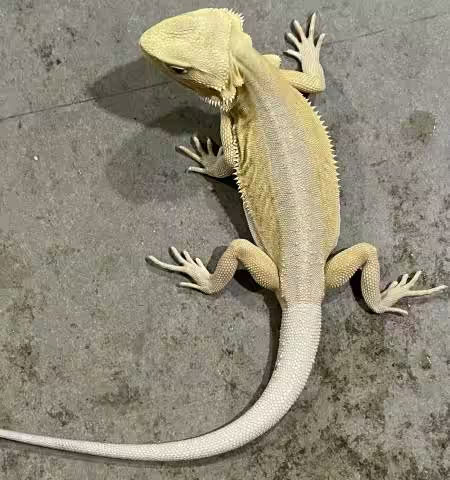
A Witblits bearded dragon is a recessive morph from South Africa. Witblits dragons are patternless and pale, often silver-grey to almost white, and they change color far less than a normal bearded dragon. The name is Afrikaans for “white lightning.” Their care is the same as for any central bearded dragon: an enclosure of at least 4 x 2 x 2 feet, a hot basking spot, a linear UVB tube and a diet that shifts from insects to greens with age.
What “Witblits” Means
Origin of the name
The Witblits morph appeared in South African captive lines and reached breeders in Europe and the US in the early 2010s. “Witblits” is also the name of a strong South African home-distilled spirit, which is where the “white lightning” translation comes from.
How Witblits dragons look
- No pattern: the back lacks the usual stripes, chevrons and spots.
- Pale base color: light grey, silver, tan or off-white, often with a faint yellow or peach tone.
- Little color change: a normal dragon darkens a lot when cold or stressed, a Witblits much less.
- Normal scales: unless the dragon also carries leatherback or silkback genes.
Witblits vs Zero
The Zero morph from the US looks similar: patternless and pale. The two morphs come from different genes. Breeding a Witblits to a Zero produces normal-looking offspring that carry both genes, and a later generation can produce “Wero” dragons with traits of both.
Genetics
Witblits is recessive. A dragon has to inherit the gene from both parents to look like a Witblits. A dragon with one copy looks normal but is “het” (heterozygous) for Witblits and can pass the gene on.
| Pairing | Expected offspring |
|---|---|
| Witblits x Witblits | All Witblits |
| Witblits x het Witblits | About half Witblits, half het |
| Witblits x normal | All normal-looking, all het Witblits |
| Het x het | About one quarter Witblits |
🦎 Want all the essentials on one printable page?
The Complete Bearded Dragon Care Plan puts daily routines, feeding charts, safe vs. toxic foods and vet red flags into one 16-page PDF for $7.99.
See the Care Plan →Choosing a Witblits Bearded Dragon
Health checks
Look for bright, clear eyes, a full and rounded tail base, a straight tail and spine, clean skin and an alert dragon that eats in front of you. Pass on a dragon that is thin, lethargic, has stuck shed on its toes or tail tip, or shows a soft jaw.
Ask the breeder
- photos of both parents and their morph status
- whether the dragon is a visual Witblits or “het”
- hatch date, current weight and feeding schedule
- any health problems in the line, such as egg binding or metabolic bone disease
Prices for visual Witblits run higher than for normal dragons. Be careful with sellers who use “Witblits” for any pale dragon without proof of the parents.
Age
A juvenile of 3 to 6 months is past the fragile hatchling stage and still young enough to get used to handling. A subadult also shows its final color better, which helps when you want a clear Witblits look.
Enclosure Setup
Size and substrate
House an adult in an enclosure of at least 120 x 60 x 60 cm (4 x 2 x 2 feet). A juvenile can start smaller but should move up by about 6 months. Use tile, paper towels or a packed soil and play sand mix. Avoid loose calcium sand.
Light and heat
- A linear T5 high-output UVB tube across half the enclosure, 10 to 12 hours a day, with a UV index of about 4 to 6 at the basking spot.
- A halogen basking bulb that brings the basking surface to 38 to 42°C (100 to 108°F) for adults.
- A cool side of 24 to 29°C (75 to 85°F).
- At night, lights off and a drop to 18 to 24°C (65 to 75°F). Add a ceramic heat emitter on a thermostat if your room gets colder than that.
Furnishings
Add a stable basking rock or branch under the lamp, a hide on the cool side, a second hide or cork piece on the warm side, and a shallow water dish. Shaded spots under bark or plants give a nervous dragon a place to settle.
Feeding
Insects
Offer gut-loaded crickets, dubia roaches and black soldier fly larvae, with hornworms as an occasional extra. Juveniles get insects once or twice a day. Adults get insects two to three times a week.
Greens and vegetables
Serve a daily salad of collard greens, mustard greens, dandelion greens and turnip greens, with squash and bell pepper for variety. Greens make up about 80 percent of an adult’s diet. Avoid spinach and iceberg lettuce as staples. Our feeding guide has a full list.
Supplements
Dust insects with plain calcium at most feedings for juveniles and a few times a week for adults. Use calcium with D3 about once a week and a reptile multivitamin once or twice a month. Too much D3 or vitamin A causes illness, so follow the product labels.
Daily Care and Handling
Cleaning and checks
Remove poop and leftover food every day, rinse the water dish, and check both temperatures. Once a week, wipe surfaces and hides. Once a month, deep-clean the enclosure. Our cleaning guide has the full routine.
Taming
Let your dragon walk onto your hand instead of grabbing it from above. Handle it in a calm way in short sessions, support the whole body and stop if it puffs its beard or hisses. Hand-feeding with tongs near the time you handle it helps build trust.
Health
Metabolic bone disease
A soft jaw, twitching limbs, tremors and a floppy posture point to metabolic bone disease. The causes are weak UVB, too little calcium or both. See a reptile vet at the first sign.
Parasites and skin
Have a vet run a fecal test for parasites when you bring a new dragon home and once a year after that. Mites show up as tiny moving specks around the eyes and ears. Treat them with products your vet recommends and separate the dragon from other reptiles.
Signs of illness
Loss of appetite, constant hiding, weight loss, a black beard that stays dark and open-mouth breathing when not basking all need attention. A Witblits darkens less than a normal dragon, so watch behavior and appetite more than color.
Breeding Witblits Dragons
Breed healthy adults that are at least 18 months old and at a good weight. Plan the pairings around the genetics table above, and make sure you can house and sell 15 to 30 hatchlings per clutch. Discussions on beardeddragon.org cover common pairings.
Incubate the eggs at about 29 to 31°C (84 to 88°F) in damp vermiculite or perlite. They hatch after about 55 to 75 days. Set up the hatchlings like juveniles, scaled to their size. Read our breeding guide before you start.
Costs
Expect several hundred dollars for the setup: the enclosure, lighting, heating, hides, substrate and thermometers. Ongoing costs include live insects, fresh greens, supplements, electricity, a new UVB tube every 12 months and a yearly vet check.
Myths About Witblits Dragons
- “Witblits dragons are tougher.” The morph affects color and pattern, not health.
- “They need a special diet.” They eat the same diet as any bearded dragon.
- “They need extra UVB because they are pale.” Too much UVB harms any dragon. Stick to a UV index of about 4 to 6 at the basking spot.
- “Any pale dragon is a Witblits.” A dragon needs two copies of the gene to be a visual Witblits. Ask for proof of the parents.
Frequently Asked Questions
What makes a bearded dragon a Witblits?
Two copies of the recessive Witblits gene. Visual Witblits dragons are patternless, pale and change color less than normal dragons.
Do Witblits dragons need a different diet or UVB?
No. They need the same diet, heat and UVB as any central bearded dragon.
How often should I replace the UVB lighting?
Replace a T5 tube every 12 months and a T8 tube every 6 months, even if it still glows.
Can I breed a Witblits with a non-Witblits dragon?
Yes. All offspring will look normal but carry the gene. Breeding two of those offspring, or one back to a Witblits, can produce visual Witblits.
What is the biggest mistake new Witblits owners make?
Buying a “Witblits” without proof of the parents, and skimping on UVB, heat or substrate safety. The care basics matter more than the morph.

Love your beardie? Wear it proudly.
I'm in Beardie Mode Tee – from $15.83. Our own bearded dragon designs, printed on demand. Every order supports these free care guides.
View this design → Browse all gifts